










Solutions
Explore how to grow
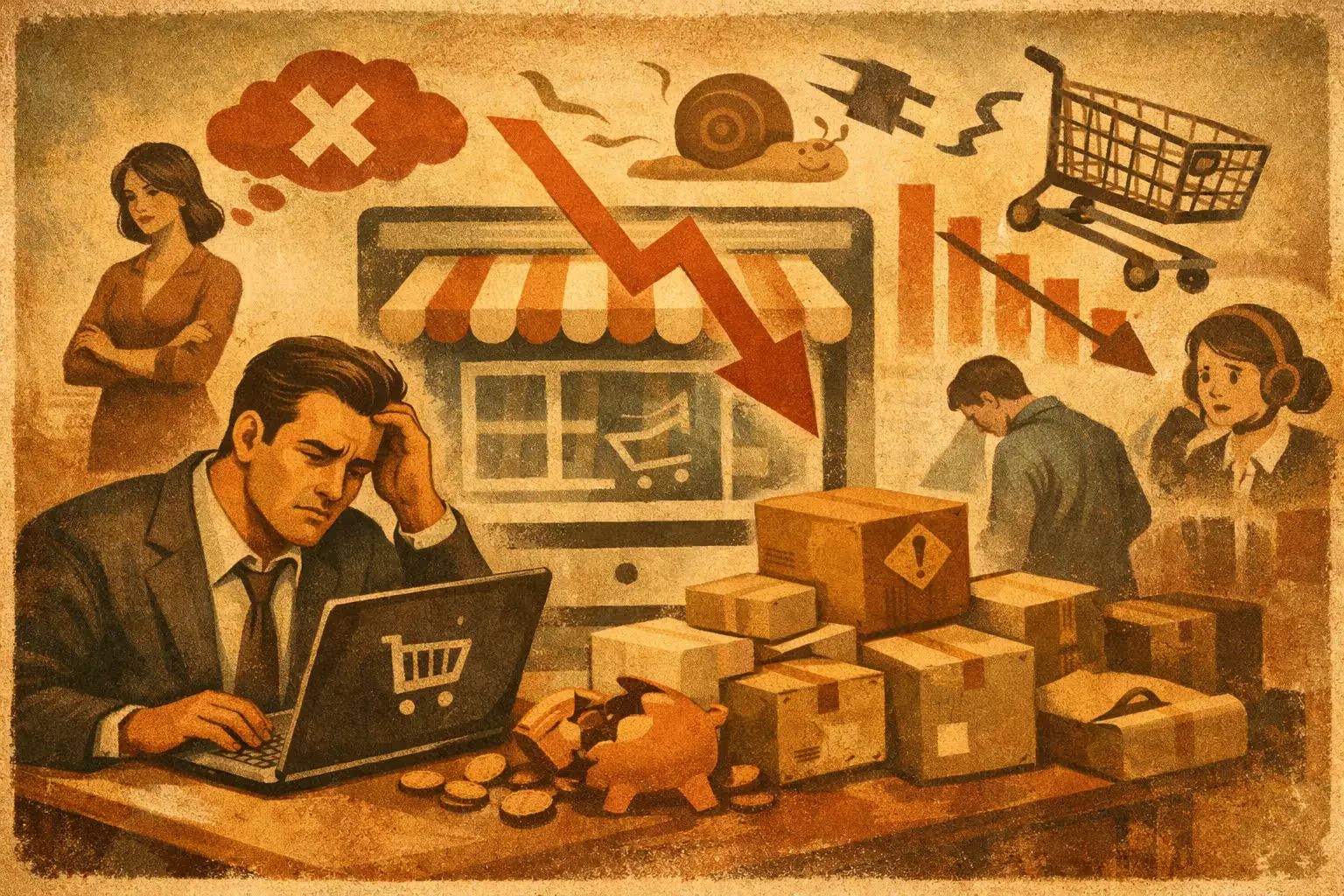
Selling on Shopify rarely fails because of the platform. It fails because of poor decisions in design, structure, configuration, and conversion. When a store gets traffic but can't consistently turn visits into sales, there's almost always a combination of common Shopify mistakes affecting the experience, the trust, or the buying process.
At Bigbuda, we help you with an optimized Shopify store.
The problem is that many of these mistakes aren't obvious at first glance. A store can “look good,” load reasonably well, and even have active campaigns. But if users get confused, can't quickly find what they're looking for, or sense friction at checkout, the sale is lost. And losing sales with the same traffic is one of the highest costs in ecommerce.
Not all mistakes have the same impact. Some hurt your conversion rate directly, while others drive up your acquisition cost because they force you to spend more on ads to make up for a site that doesn't convert well. The difference between a store that grows and one that stalls usually comes down to these details.
One of the most common mistakes is prioritizing eye-catching aesthetics over commercial clarity. A store can have a polished visual identity and still sell very little if users don't quickly understand what's being sold, why they should trust you, and how to move forward.
This happens when the homepage is crowded with banners, vague messaging, or blocks that look nice but don't help the customer decide. It also happens when the value proposition is buried and visitors have to “interpret” the offer. In ecommerce, clarity sells more than decoration.
Good design doesn't just represent the brand. It directs attention, reduces friction, and drives the decision. If your site makes people think too hard, it converts less.
Site architecture matters more than many brands realize. Long menus, unclear categories, poorly configured filters, or badly labelled products all waste the user's time. And when people waste time, they leave.
On Shopify, this often happens in catalogues that grew without solid logic. Collections, subcollections, and variants get added without reviewing the overall experience. The result is a store where the product exists, but finding it is far too much work.
Efficient navigation cuts steps and makes discovery easier. It's not about showing everything. It's about showing the right thing at the right moment.
Many stores invest in attracting traffic but neglect the point where the sale is actually decided: the product page. This is one of the common Shopify mistakes with the most direct impact on revenue.
A weak product page usually has generic descriptions, not enough photos, little technical information, calls to action that are hard to spot, and a lack of trust signals. And if it doesn't address objections like shipping, returns, delivery times, or real stock, the conversion rate drops.
Not every category needs the same depth. A simple product can convert with a short, clear page. A higher-value or more comparison-heavy product needs more context. That's the nuance: it's not about filling the page with text, but delivering the precise information that makes the decision easier.
Many teams review campaigns, creatives, and products but leave the final stretch of the funnel untouched. That's a costly mistake. If the cart and checkout have friction, all that earlier effort loses its value.
The most common issues are surprise costs, unnecessary steps, too many form fields, limited payment methods, and a lack of clarity around shipping. In some cases, the user arrives at the cart motivated and stops right before paying because they don't understand the final total or can't find a payment option they trust.
On Shopify, part of this process is handled by the platform, but that doesn't mean it's optimized by default. There are configuration, presentation, and messaging decisions that can change performance significantly.
Shopify has a powerful ecosystem. That's a benefit, but also a trap. Many brands install apps to solve every little need without measuring the cumulative cost in speed, compatibility, and stability.
Every extra script can affect load time, mobile experience, and visual consistency. On top of that, several apps end up performing similar functions, creating conflicts or duplicating processes. The result isn't just technical. It's commercial too: a slower store converts less.
This isn't about using few apps on principle. It's about using only the ones that create real value. If an integration doesn't improve conversion, operations, or measurement, it's probably getting in the way.
In Canada and across North America, a large share of ecommerce traffic comes from mobile. That's why a store that loads well on desktop but poorly on mobile is losing sales every day.
The causes tend to repeat: heavy images, poorly implemented videos, too many scripts, unnecessary sliders, and badly optimized themes. The worrying part is that brands often don't notice, because they check the site on a strong connection or a powerful device.
Speed doesn't just affect the experience. It also affects product browsing, session depth, and campaign performance. If every page is slow to respond, users browse less and buy less.
A store can have competitive products and a solid ad budget, but if its technical foundation is poorly built, scaling becomes more expensive. This is where less visible — but equally important — mistakes show up.
A common mistake is assuming Shopify “handles” organic ranking on its own. The platform helps, but it doesn't replace a strategy. If categories are poorly defined, product titles are weak, meta descriptions are duplicated, and the internal structure doesn't match search intent, the organic channel stays limited.
It's also common to see stores with descriptions copied straight from the supplier or empty collection pages. That reduces differentiation and makes it harder to capture searches with buying intent. You don't need to publish content for the sake of publishing. You need to build pages that truly compete and convert.
If you don't measure well, you optimize blindly. And in ecommerce, that catches up with you fast. Many stores have Shopify, Google Ads, Meta Ads, and analytics running only “halfway,” with duplicated events, misattributed purchases, or incomplete funnels.
The problem isn't just reporting. It affects business decisions. If you don't know which channel brings in higher-value buyers, where people drop off, or which device performs worst, it's hard to prioritize real improvements.
Useful analytics aren't there to decorate dashboards. They're there to spot leaks and allocate budget more precisely.
This is usually the structural mistake. Many brands launch the store and then only react to problems. They make changes when sales drop, when a competitor shows up, or when acquisition costs rise. But they never work on continuous optimization.
Profitable growth on Shopify doesn't depend solely on attracting more traffic. It depends on improving conversion, average order value, and funnel efficiency through systematic testing, analysis, and adjustments. That means reviewing heatmaps, user behaviour, checkout abandonment, performance by device, and how key templates perform.
Not every change brings an improvement. Sometimes simplifying converts more. Other times adding context improves trust. That's why CRO isn't opinion. It's hypothesis, testing, and data-driven decisions.
It's not wise to fix everything at once. The most efficient approach is to prioritize by commercial impact. First, review product pages, cart, checkout, and the mobile version. That's usually where the biggest revenue leak is. Next, sort out navigation, speed, and measurement. Finally, strengthen technical SEO and content with a transactional focus.
It also matters to distinguish between visible mistakes and costly ones. A visual detail can be annoying, but a poor product structure or a confusing checkout hurts sales immediately. Priorities should follow the money, not just the aesthetics.
For internal teams, this requires a shift in mindset. Shopify shouldn't be managed like a digital storefront, but as a commercial asset that's optimized the same way you'd optimize a campaign or a sales channel. When design, technology, content, and analytics work in sync, performance changes.
At Bigbuda, we see it all the time: brands with enough traffic, good products, and active campaigns, but with friction that holds growth back. The point isn't to have a “pretty” store. The point is to have a store that converts better with the same traffic.
If your Shopify ecommerce already has visits, the next leap isn't always about spending more. Often it's about fixing what's currently holding back sales without your team noticing in time. That's where a well-focused improvement starts moving real numbers.
Related article: Shopify for businesses: when it's actually worth it.
Selling on Shopify rarely fails because of the platform. It fails because of poor decisions in design, structure, configuration and conversion. A store can look good, load reasonably and run campaigns, but if users get confused or sense friction at checkout, the sale is lost.
Only the ones that create real value. Every extra script can affect load time, mobile experience and visual consistency, and several apps end up duplicating functions or creating conflicts. The result is commercial, not only technical: a slower store converts less. If an integration does not improve conversion, operations or measurement, it is getting in the way.
The platform helps, but it does not replace a strategy. If categories are poorly defined, product titles are weak, meta descriptions are duplicated and the internal structure does not match search intent, the organic channel stays limited. Supplier-copied descriptions and empty collection pages reduce differentiation too.
Generic descriptions, not enough photos, little technical information, calls to action that are hard to spot and no trust signals. If it does not address objections like shipping, returns, delivery times or real stock, conversion drops. Not every category needs the same depth, but the information must be precise.
Improving conversion, average order value and funnel efficiency through systematic testing, analysis and adjustments, instead of reacting only when sales drop or acquisition costs rise. That means reviewing heatmaps, user behaviour, checkout abandonment, performance by device and how key templates perform. CRO is hypothesis, testing and data-driven decisions.
Prioritize by commercial impact. First review product pages, cart, checkout and the mobile version, where the biggest revenue leak usually is. Next sort out navigation, speed and measurement. Finally strengthen technical SEO and transactional content. Priorities should follow the money, not just the aesthetics.