










Solutions
Explore how to grow
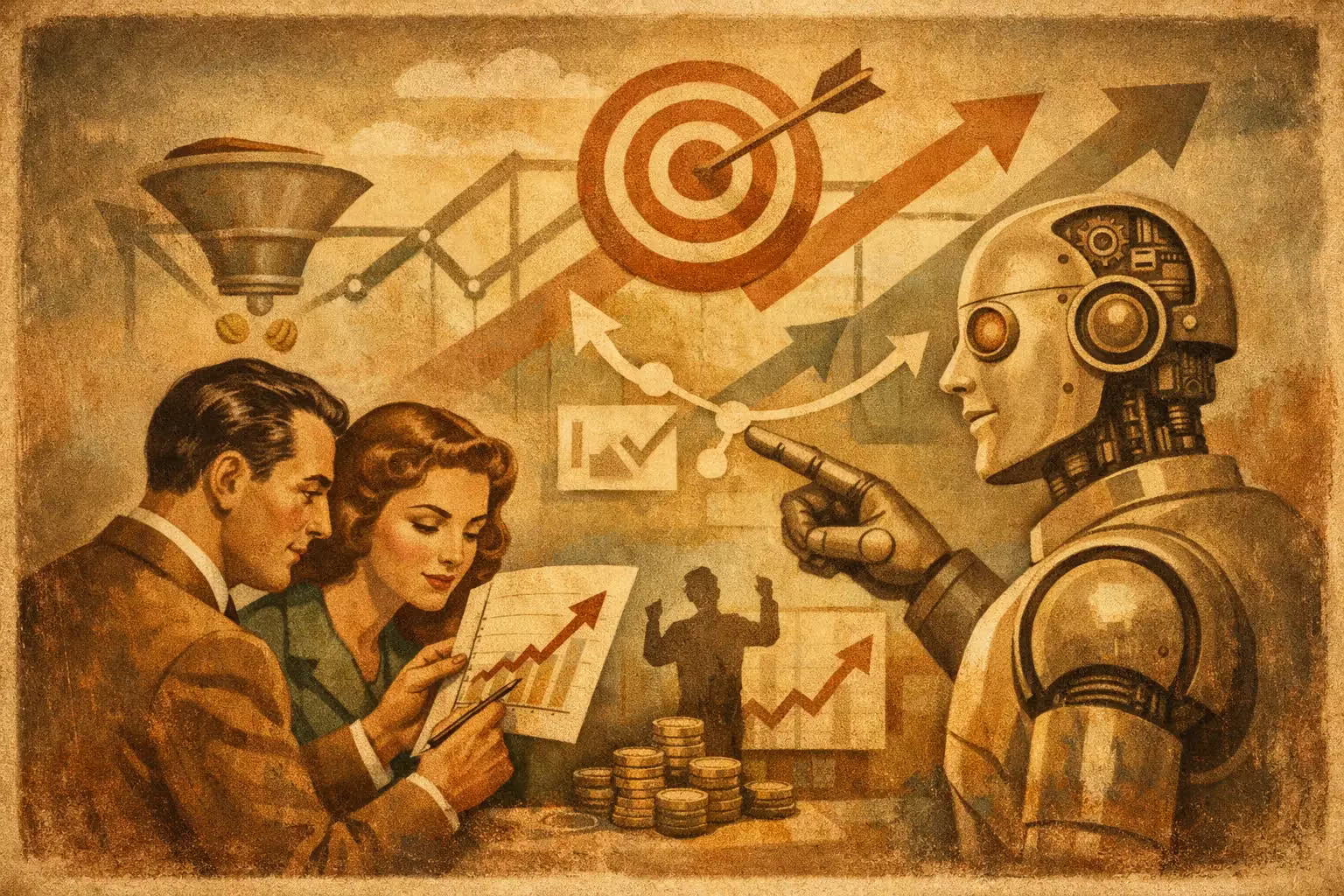
If your site already gets visits but does not convert the way it should, the problem is not always traffic. Often it is friction: long forms, weak messaging, slow load times, poorly placed CTAs, or an offer that is not understood quickly. That is where ai to optimize conversions can make a real difference, but only when it is used with commercial judgment and not as a decorative layer.
The promise sounds tempting: more sales, more leads, and better conversion rates without increasing media spend. It is partly true. AI can speed up analysis, detect behavior patterns, and help prioritize changes with greater precision. What it does not do, on its own, is fix a confusing value proposition or make up for a poor user experience.
Talking about AI in CRO is not talking about a magic button. It is using models, automations, and predictive systems to answer concrete business questions: which users have the most purchase intent, at which funnel step the most value is lost, which version of a page is most likely to convert, or which segment needs a different message.
In practice, AI contributes mainly on four fronts. First, behavior analysis at scale. Second, content and offer personalization. Third, experiment prioritization. Fourth, automation of commercial responses. The value appears when those fronts connect with hard metrics like conversion rate, cost per acquisition, average order value, and close rate.
For a service company, for example, this can mean identifying which type of lead is closest to booking a meeting and showing them a more direct landing page. In ecommerce, it can help detect which combinations of product, price, urgency, and social proof raise revenue per session. This is not theory. It is optimization applied to the result.
The first clear case is the analysis of sessions, heatmaps, and aggregate behavior. When traffic volume grows, reviewing data manually becomes slow and partial. AI makes it possible to detect anomalies, repeated patterns, and drop-off points faster. That shortens the time between spotting a problem and executing an improvement.
It also works very well in personalization. Not every visit has the same intent. A user arriving from an informational organic search should not see exactly the same experience as someone coming from a remarketing campaign or a transactional search. Adjusting headlines, trust blocks, CTAs, or content according to intent can increase relevance and, with it, conversion.
Another powerful use is in lead scoring. Many companies generate forms, but the sales team receives contacts of very uneven quality. AI can help score those leads based on historical variables and on-site behavior. The result is not only more commercial efficiency. It also improves response speed where it matters most.
In ecommerce, product recommendation remains one of the most profitable areas. Well implemented, AI can raise cart value, reduce abandonment, and improve the discovery experience. But there is a condition: the catalog, navigation, and site structure have to be well resolved beforehand.
Here it is worth being direct. If your site loads slowly, the checkout has friction, the main message does not communicate value, or the information architecture is poorly built, AI is not going to save performance. It can help you detect the problem faster, but it does not replace strategy, UX, or technical implementation.
Nor is it wise to delegate critical decisions to automatic recommendations without context. A model can suggest a variant that improves clicks, but not necessarily qualified sales. It can drive more forms submitted, but with lower commercial intent. In CRO, optimizing an isolated metric sometimes worsens the final result.
That is why judgment matters as much as technology. The question is not whether to use AI, but where it adds the most room for improvement and how its impact is validated with real testing.
The starting point should not be the tool, but the objective. If a company needs more qualified meetings, the strategy will differ from that of an ecommerce looking to raise average order value or reduce cart abandonment. AI comes in afterward, as an accelerator.
Not all conversion problems carry the same weight. Sometimes a landing page underperforms, but the biggest impact is in the contact form. In other cases, the problem is in the evaluation stage: low trust, unresolved objections, or messages that are too generic.
The best application starts with a clear audit of the funnel. Traffic, interaction, micro-conversions, leads, sales, and retention. Once you identify the segment with the greatest loss of value, only then does it make sense to add AI to analyze patterns or activate personalization.
One of the most common mistakes is working on conversion only from web analytics. That leaves out key information from the CRM, the sales team, and post-conversion behavior. If a campaign brings in forms, but those leads do not advance, the problem is not volume. It is quality.
AI works best when it cross-references sources. Sessions, scroll, clicks, traffic origin, behavior on key pages, purchase history, and commercial outcome. That integrated view allows for more profitable and less intuitive decisions.
Personalization can improve conversions, but it can also fragment the experience too much and make it harder to measure what is working. Not everything needs a different version for each segment.
In most cases, it is enough to intervene at specific moments: the main hero, social proof, the offer, the CTA, and follow-up sequences. That is usually where the greatest leverage lies. Personalizing beyond that is only worthwhile when traffic volume and business value justify the complexity.
AI can generate hypotheses very quickly. That does not mean they are all good. Before making structural changes, it is worth validating with controlled tests, reviewing quality metrics, and observing impact by segment.
In serious CRO, an improvement is not declared by intuition or a one-off bump in clicks. It is confirmed when the change moves a business metric consistently.
There are many platforms that promise predictive analysis, personalization, intelligent chat, automated testing, and dynamic recommendations. Some are useful. Others end up adding complexity without moving results.
The difference is not in having more software. It is in having an optimization system where each tool serves a specific function. Analytics to detect, UX to interpret, development to implement, testing to validate, and business to prioritize. Without that structure, AI becomes just another layer of noise.
That is why the companies that achieve sustained improvements do not treat conversion as a one-off task. They work on it as a continuous process. They measure, correct, learn, and iterate again. Same traffic. Better results.
There is no universal percentage. It depends on the channel, the maturity of the site, the type of business, and the quality of the available data. On a site with a lot of disorder, simple improvements supported by AI can generate relevant progress in a short time. In more mature operations, the effect usually comes from accumulating small but constant optimizations.
The important thing is not to buy inflated promises. AI well applied can speed up decisions and increase the precision of CRO. That is already valuable. But the real impact appears when it is combined with a clear value proposition, a solid conversion architecture, and a friction-free experience.
If your company already invests in traffic and feels that the site could sell more with what it receives today, there is a concrete opportunity there. In that scenario, working with specialists in CRO, strategic design, and digital performance like Bigbuda can make the difference between adding tools and building a system that truly converts.
AI does not replace strategy. It makes it faster, more informed, and, when well implemented, considerably more profitable. The right question is not whether you should use it. It is how much you are failing to sell by not applying it where it hurts most.
Related article: CRO checklist for service sites.
It is not a magic button. It is using models, automations and predictive systems to answer concrete business questions: which users have the most purchase intent, at which funnel step the most value is lost, which version of a page is most likely to convert, or which segment needs a different message.
In four areas. Analysis of sessions, heatmaps and aggregate behavior, which shortens the time between spotting a problem and fixing it. Personalization according to visit intent. Lead scoring based on historical variables and on-site behavior. And product recommendation in ecommerce, provided catalog and navigation are already resolved.
If your site loads slowly, the checkout has friction, the main message doesn't communicate value or the information architecture is poorly built, AI is not going to save performance. It helps you detect the problem faster, but it doesn't replace strategy, UX or technical implementation, and critical decisions still need context.
Personalization can improve conversions, but it can also fragment the experience and make it harder to measure what is working. In most cases it is enough to intervene at specific moments: the main hero, social proof, the offer, the CTA and follow-up sequences. Going further is only worthwhile when volume justifies the complexity.
AI can generate hypotheses very quickly, and that does not mean they are all good. Before making structural changes, validate with controlled tests, review quality metrics and observe impact by segment. In serious CRO, an improvement is confirmed when the change moves a business metric consistently, not by a one-off bump in clicks.
There is no universal percentage. It depends on the channel, the maturity of the site, the type of business and the quality of the available data. On a site with a lot of disorder, simple improvements supported by AI can generate relevant progress in a short time. Mature operations accumulate smaller, constant gains.